

Battery Health, Hours, Abuse: The Off‑Sheet Risks Undermining Golf Cart and Turf Leases
For banks and finance companies, golf carts and small turf equipment like mowers, greens rollers, aerators, and compact utility vehicles may look like low-ticket, low-risk assets. They are not. The dollars per unit are modest, but fleet counts are high, and usage is hard to standardize. Residual outcomes swing wildly based on factors not visible on a spreadsheet: battery health, hours, abuse, and modifications.
In a used-equipment market already shaped by rate uncertainty and capex caution, the gap between “looks OK” and hidden condition issues makes a difference.
Why Golf Carts and Turf Equipment Are Small Assets with Big Risks
Unlike trucks or yellow iron, golf carts and turf equipment rarely fail catastrophically; they fail cumulatively. Tires, brakes, steering slop, corrosion, weak batteries, and hacked wiring quietly erode performance and value long before a unit is formally “down.” On paper, the lease looks fine; in the field, the portfolio may be aging and wearing faster than the residual assumed.
Several factors amplify that risk for lenders, making third-party inspections a critical portfolio management tool, not just a “nice-to-have.”
High fleet counts, low unit values: A single unit write-down might be small, but across dozens or hundreds of units, cumulative loss severity adds up quickly at lease-end or repo.
Extreme variability by duty cycle: The same model-year cart can be pampered at a private club or beaten up in resort rental or industrial shuttle duty. Same on paper but with radically different steering, brakes, and frame condition.
A choppy used market: The used equipment market is unsettled; rates, capex, and buyer appetite are all in motion, and the gap between expected and actual condition is wider than usual. That puts a premium on tight portfolio management.
Hidden Risks Lenders Miss that Independent Inspections Reveal
From the outside, a golf cart or mower can appear to have normal wear, but there may be hidden issues that can make or break residual value. This is where an independent inspection can quantify that risk and help determine whether an asset is ready to re-lease, needs thousands in reconditioning, or should go straight to wholesale.
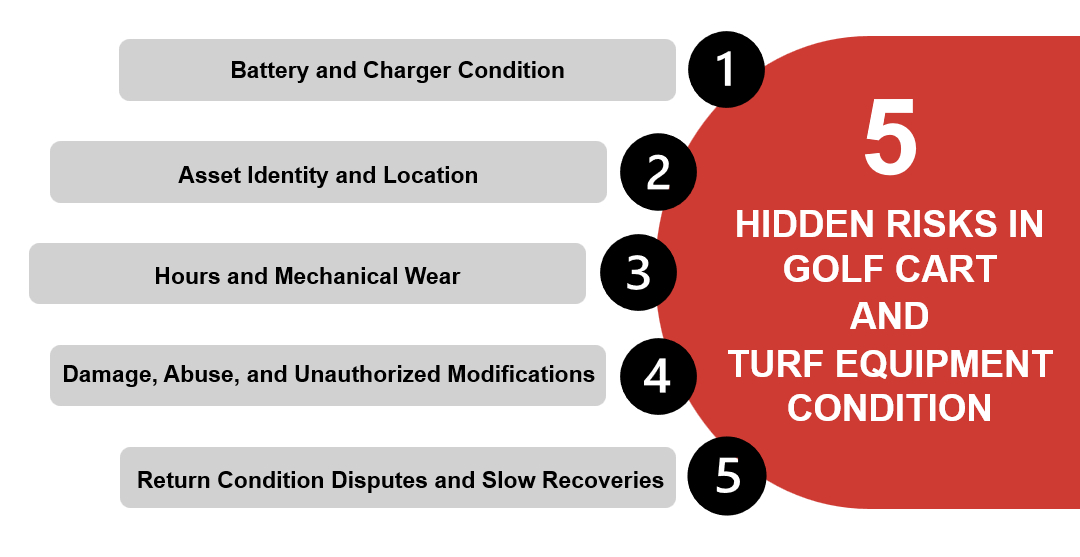
Battery and Charger Risk: For electric fleets, the battery is the big one. Battery condition can be the difference between a unit that re-enters service, one that needs a full pack replacement, and one that requires expensive refurbishment before it can be remarketed. Key issues that rarely surface in a borrower’s self-report:
State of Health (SOH) vs. State of Charge (SOC): A pack can show “full” on the gauge but be near end-of-life in terms of usable capacity and cycle count.
Mixed and mismatched packs: Mixed ages in the same pack, corrosion, damaged cables, and chronic under/overcharging from the wrong charger quietly destroy longevity and resale value.
Undocumented chemistry changes: Lead-acid–to–lithium conversions, DIY wiring, and non-OEM chargers can all change risk, safety profile, and market value, especially if not documented.
Asset Identity and Location
In golf, turf, and material handling fleets, assets move. Without verification, lenders face:
Serial/VIN mismatches or missing plates: Units get swapped inside a fleet, undocumented replacements happen, plates go missing — all impacting value.
“It exists” risk: When vehicles shift between properties or courses, it is important to verify that collateral actually exists where and how the contract says it does.
Hours and Mechanical Wear
Cosmetics mislead. A cart or mower can be clean, freshly detailed, and mechanically compromised:
High-hour units with “retail-ready” paint: Worn bushings, loose steering, soft brakes, and tired suspensions often aren’t visible to the naked eye but can indicate high hours or hard use.
Hour-meter gaps: Missing or unreliable meters or discrepancies between recorded hours and visible wear make it hard to accurately price residuals or structure re-lease terms.
Damage, Abuse, and Unauthorized Modifications
What appears to be normal wear and tear can mask expensive or high-liability problems:
Structural and water damage: Frame corrosion or cracks, water intrusion into electronics, hacked harness repairs, and bent suspension components can all turn into safety and resale issues.
Modifications with liability impact: Lift kits, controller changes for higher speed, rear seat add-ons, lighting kits, and street-legal conversions can change stability and braking → increasing liability exposure.
Return-Condition Disputes and Slow Recoveries
Without an inspection standard and photos, “wear vs. damage” can become a negotiation. That leads to:
Slower decisions on curtailments, extensions, and settlements
Higher loss severity when remarketing is delayed or buyers push back on condition
More internal time spent untangling “who did what, when” at lease-end
How Custom Inspection Solutions Helps Remove Risk from Golf Cart and Turf Portfolios
Custom Inspection Solutions (CIS) specializes in decision-grade equipment inspections for Finance—including golf carts, turf machines, and similar small assets. Our approach is structured around how sophisticated lessors think about portfolio risk, asset management, and residual protection.
Verified Identity and Documentation
Every CIS inspection starts by verifying exactly what your customer has:
Make, model, year, serial/VIN, and fleet ID verification
Hour meter readings, charger serials, and battery make/date codes
Location and status confirmation for each unit
Functional Safety and Mechanical Condition
CIS looks beyond cosmetics and comprehensively evaluates operational safety:
Drive/stop tests, brake hold, steering play, and suspension noise
Tire condition and age, lights and horn (if equipped), and basic safety interlocks
Highlighting required repairs and reconditioning needs
Battery, Electrical, and Charger Health
Because battery and charger condition drives residual value, CIS conducts:
Visual inspections for corrosion, leaks, cable damage, and DIY modifications
Battery voltage checks and, where feasible, load/health indicators that mirror SOH-style insights rather than just SOC snapshots
Condition Grading, Repair Exposure, and Media
CIS reports are built for finance, not the shop floor:
Standardized condition reports with a short list of cost-driving defects (e.g., needs pack replacement, steering work, front-end rebuild)
A consistent photo set (all sides, serial plate, hour meter, battery compartment, undercarriage hot spots) and, when relevant, short videos
Clear separation between normal wear and damage/abuse, making chargebacks and settlements defensible
Practical Applications for Banks and Finance Companies
For lenders financing golf cart and turf leases, CIS inspections can be valuable at several points in the asset lifecycle:
At origination, to validate collateral on larger or multi-site deals
Mid-term, as part of portfolio reviews, curtailment checks, or covenant monitoring
End-of-lease, to support re-lease decisions, purchase options, and return-condition settlements
Post-default, to establish realistic recovery values and prioritize reconditioning spend
Different points in the lifecycle, same impact: fewer surprises, faster decisions, and tighter alignment between booked residuals and real-world equipment condition.
The Bottom Line
In a segment where “small” assets can quietly drive large cumulative losses, third-party inspections from Custom Inspection Solutions give banks and finance companies the one thing their spreadsheets cannot provide on their own: consistent, accurate documentation of the condition and value of the vehicles they own. That’s the difference between portfolio management built on assumptions and portfolio management built on what’s actually in the field.